- January 27, 2026
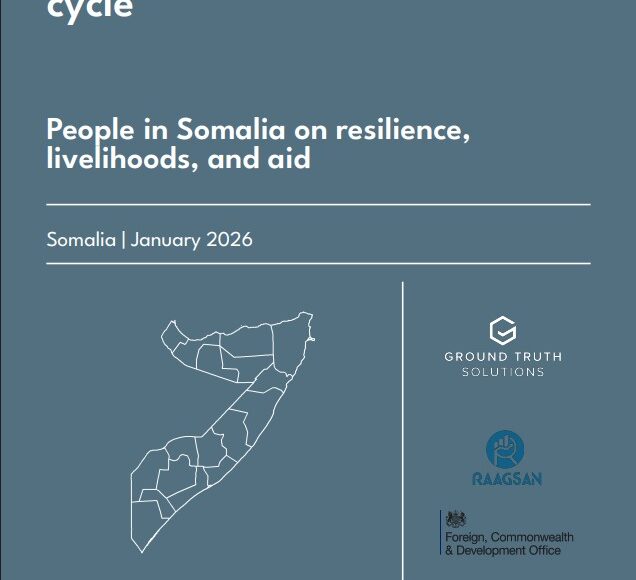
“We are stuck in a vicious cycle”: People in Somalia on resilience, livelihoods, and aid
People across Somalia see their situations becoming more precarious, and the challenges they confront becoming more intractable. To address this people want support which helps them build better futures, not just meet their immediate needs. Based on a survey of 7,460 people across 11 districts in Somalia, this report shows that communities want support to help meet today’s most urgent needs and to build futures that are less dependent on aid, less exposed to climate shocks, and more economically secure. Instead, many are caught in a cycle of fragile livelihoods, eroding
social support, widening inequality, and accelerating climate risks. People are clear about what resilience means to them, and why it feels increasingly out of reach. This research is based on a participatory co-design process,
Where community members defined their key priorities to direct the research design. Communities we spoke to are clear that their focus is on building more resilient and independent futures. They define resilience as the ability withstand an income shock without losing one’s assets, resources, or livelihoods entirely – in other words, minimising losses during a shock, allowing households to maintain as much of their original level of subjective wellbeing as possible as they emerge from that shock.
Using this definition, the report introduces a perception-based resilience index spanning the five dimensions people told us were the most important drivers of resilience: access to assets and livelihoods, social capital, climate coping capacity, and access to services and security.
Respondents are clear that without reliable livelihoods, access to basic services, and the resources to adapt to climate change, resilience remains out of reach. IDPs, women, people in rural areas, and marginalised groups consistently fare worst across all dimensions of resilience.
To read more, click on the download button below!